

WASHINGTON: The James Webb space telescope has taken its first image of an exoplanet — a earth outside our solar system as astronomers hail the device’s performance since its launch last time.
 |
| google source |
Images from the most important space telescope ever erected have thrilled spectators in recent months as it orbits the Sun a million long hauls(1.6 million kilometres) from Earth.
Its rearmost pioneering filmland show the exoplanet, called hipsterism 65426 b, is a gas mammoth with no rocky face and couldn't be inhabitable.
“ This is a transformative moment, not only for Webb but also for astronomy generally, ” said Sasha Hinkley, an astronomy professor at the University of Exeter, who led the observation platoon.
Webb’s infrared aspect
and coronagraphs telescopic attachments that block out starlight — enable it to take direct images of exoplanets.
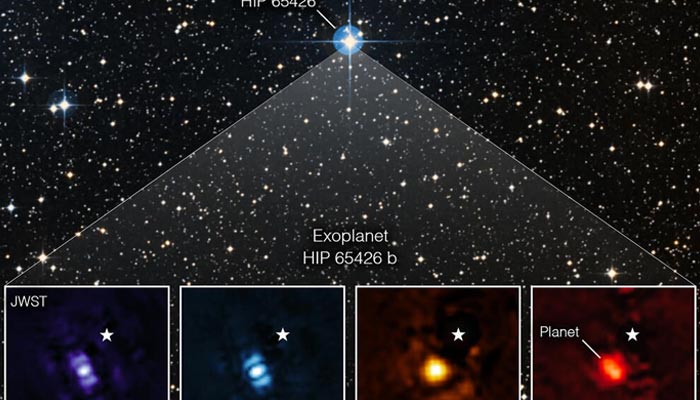
A James Webb Space Telescope direct image of an exoplanet — the image shows HIP 65426 b in different bands of infrared light. — AFP
“ It was really emotional how well the Webb coronagraphs worked to suppress the light of the host star, ” Hinkley said in a NASA statement on Thursday.
The hipsterism 65426 b exoplanet is six to 12 times the mass of Jupiter and youthful — about 15 to 20 million times old, compared to the4.5- billion- time-old Earth.
The telescope, which only released its first images in July, has formerly revealed glowing new detail of the Phantom Galaxy and of the earth Jupiter.
The Hubble space telescope preliminarily captured direct exoplanet images, but in far lower detail.
“ I suppose what’s most instigative is that we ’ve only just begun, ” said Aarynn Carter, of the University of California. “ We may indeed discover preliminarily unknown globes. ”
The$ 10- billion Webb telescope is a collaboration between NASA, the European Space Agency and the Canadian Space Agency. It's anticipated to operate for roughly 20 times.


0 تبصرے